
Need a BRE365 infiltration test or BRE365 percolation test for your planning application? Nimbus Engineering provides professional on-site testing and comprehensive reporting across the UK — essential for soakaway design and SuDS compliance.
A BRE365 test — also known as a BRE365 infiltration test or BRE365 percolation test — is the industry-standard method for determining how quickly water can drain into the ground at a development site. Defined in BRE Digest 365, it provides the infiltration rate data essential for designing soakaways and other infiltration-based Sustainable Drainage Systems (SuDS).
The test involves excavating trial pits to the proposed soakaway depth, filling them with water to a depth of at least 300mm, allowing the water to drain completely, then refilling and recording the rate at which the water level drops over time. This process is typically repeated three times to establish a consistent infiltration rate.
At Nimbus Engineering Consultants, we carry out BRE365 infiltration testing and BRE365 percolation testing across the UK, drawing on over 30 years' experience to provide comprehensive test reports suitable for submission to your Local Planning Authority and Lead Local Flood Authority (LLFA).
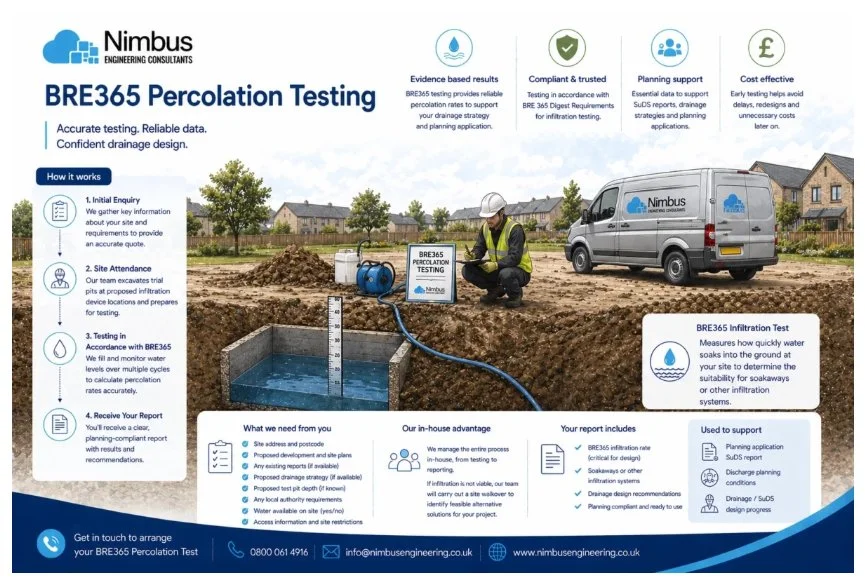
If your SuDS drainage strategy proposes infiltration-based methods — soakaways, infiltration trenches, or unlined permeable paving — the Lead Local Flood Authority (LLFA) will require BRE365 test results to prove the ground can absorb water at an adequate rate.
Without a valid BRE365 percolation test, your planning application is likely to be refused or delayed. A BRE365 test is typically required when:

Our BRE365 infiltration testing follows the exact methodology defined in BRE Digest 365.
We excavate trial pits at the proposed soakaway locations to the required depth, typically 1-2 metres depending on the SuDS design.
The trial pit is filled with water to at least 300mm depth and allowed to drain completely. This pre-soaks the surrounding soil to simulate saturated conditions.
The pit is refilled and the water level drop is recorded at regular intervals. This is repeated three times to establish a reliable, consistent infiltration rate.
We calculate the soil infiltration rate, provide soakaway sizing calculations, and deliver a comprehensive BRE365 test report for your LLFA submission.

Not all ground conditions are suitable for infiltration. Clay soils, areas with high water tables, or contaminated land may return poor BRE365 test results. This doesn't mean your development can't proceed — it simply means the SuDS strategy needs to be adapted.
If BRE365 percolation test results show inadequate infiltration, we'll design alternative SuDS solutions:
Either way, a BRE365 infiltration test provides the evidence your LLFA needs to approve the drainage strategy — whether it's infiltration-based or not.
Before providing a quote for your BRE365 infiltration test, we typically request:
Following testing, you receive a planning-compliant BRE365 test report containing:
Your report can be used to support a SuDS Report or Drainage Strategy for planning, discharge planning conditions, or enable engineers to proceed with detailed drainage design.
We manage the entire BRE365 testing process in-house — from site testing through to reporting for planning. Because our engineers remain in constant contact with the site team, if infiltration proves unviable during testing, we will:
Conduct a thorough site walkover to identify alternative drainage solutions and discharge points.
Identify feasible alternatives — attenuation tanks, lined systems, controlled discharge to sewers.
Ensure the most practical and cost-effective drainage strategy for your project moves forward.
A complete, end-to-end BRE365 infiltration testing service.
Professional excavation of trial pits at proposed soakaway locations to the required BRE365 test depth.
Full BRE Digest 365 compliant testing with three fill cycles, timed recordings, and infiltration rate calculation.
Detailed BRE365 test report including methodology, raw data, infiltration rate calculations, and site photographs.
Using BRE365 test data to calculate the required soakaway dimensions for your development's runoff volume.
Reports formatted to meet your specific Lead Local Flood Authority requirements for planning approval.
Direct liaison with your LLFA to address queries, resolve objections, and ensure your BRE365 test results are accepted.
BRE365 testing is often the first step. We provide the full range of drainage engineering services.
Combine your BRE365 test results with a comprehensive SuDS Report for a complete planning submission.
Full SuDS design using your BRE365 infiltration data — soakaways, permeable paving, swales, attenuation, and more.
Combined FRA and SuDS Reports incorporating BRE365 test data for sites in flood zones or Critical Drainage Areas.
Detailed foul and surface water drainage designs for Building Regulations and construction.


Real feedback from clients who have used our BRE365 infiltration testing service.
"I had received 3 quotes for this service, and am glad I went with Nimbus as they put me at ease when it was clear the test was going to fail, and they carried out a site walkover and found me an alternative solution to satisfy the planners, meaning I still got a compliant SuDS report and design to crack on with my build."
"I loved the way Nimbus were straight with me from the start, as the local authority were insisting on the test but the ground was clearly clay. So Nimbus carried out the test, but also took the time to carry out a CCTV survey of my existing drainage, as well as looking for nearby ditches so that I could have an alternative solution. This took away a lot of stress."
"The BRE365 test was the last piece of the puzzle to get my planning application accepted, and Nimbus provided the fee very quickly, as well as organising the visit for a Saturday so we could get the results to the local authority before our application got rejected. I would not hesitate to recommend Nimbus."
"I was really happy with the whole process from start to completion. Nimbus ensured that the site visit was organised around dates that suited us, as well as keeping us updated throughout the process. The ground was reinstated very well, and Adam was a pleasure to have on site."
"Adam carried out our BRE365 infiltration test quickly and professionally. He explained everything clearly on site and made the whole process straightforward. The report came through promptly and helped us move forward with our planning application without delays."
"We needed a BRE365 test urgently for our planning application, and Adam was brilliant. Efficient, friendly, and clearly experienced. He even talked us through potential next steps depending on the results. Excellent service."
A BRE365 test (also called a BRE365 infiltration test or BRE365 percolation test) is a standardised method for measuring how quickly water drains into the ground at a development site. It involves excavating trial pits, filling them with water, and recording the rate at which the water level drops over time to determine the soil infiltration rate.
A BRE365 test is required when your SuDS drainage strategy relies on infiltration-based methods such as soakaways, permeable paving, or infiltration trenches. Most Lead Local Flood Authorities require BRE365 test results at the planning stage to demonstrate that the ground can absorb surface water at an adequate rate.
The cost depends on the number of trial pits required, site accessibility, and location. Costs typically start from a few hundred pounds for a single trial pit. Contact us for a free, no-obligation quote tailored to your specific site.
Typically, a minimum of one trial pit is needed per proposed soakaway location. Larger sites may require multiple pits to demonstrate consistent infiltration rates. The exact number depends on your LLFA's requirements and the scale of the development.
Poor infiltration rates don't stop your development — they simply mean the SuDS strategy needs to use non-infiltration methods instead. We'll design alternatives such as attenuation tanks, lined permeable paving, or controlled discharge to sewers. The BRE365 test results provide the evidence your LLFA needs either way.
On-site testing typically takes one full day, depending on soil conditions and the number of trial pits. The complete BRE365 test report is usually delivered within 3-5 working days of the site visit.
We carry out BRE365 infiltration testing across the entire UK, including London, the South East, South West, Midlands, East Anglia, North of England, Scotland, and Wales.
A standard percolation test (often used for septic tank drainage fields) measures infiltration from a small borehole. A BRE365 test uses a full-size trial pit at the proposed soakaway dimensions, providing more accurate and representative infiltration data for SuDS design. Most LLFAs specifically require the BRE365 methodology.
Get a free, no-obligation quote from our expert team. Professional BRE365 testing with comprehensive reporting — accepted by LLFAs across the UK.
Get Your Free BRE365 Test QuoteOr call us on 0800 061 4916